

Digestive issues are among the most common everyday complaints: bloating, pressure, that heavy feeling after even a small meal, food intolerances, and sluggish digestion that turns eating into a burden rather than a pleasure.
When the body lacks certain digestive enzymes – or when they're not active enough – nutrients can't be fully broken down into their components. Undigested carbohydrates, fats, and proteins then reach the gut, where they ferment, draw in water, and produce excess gas.
This is the classic trigger for bloating, pressure, and that uncomfortable fullness. The lower the enzymatic activity, the further this process shifts into the lower digestive tract – and the more severe the symptoms.
Many people turn to digestive enzyme supplements hoping for fast relief.
But a closer look at the market tells a sobering story: big promises, little benefit.
So why do so many consumers fall for the empty marketing claims every day – only to end up frustrated that they've wasted their money?
It comes down to how the labels are written.

Most products advertise high milligram counts – but milligrams say almost nothing about how effective the enzymes actually are. What matters isn't the amount in the capsule. It's how powerfully the enzymes can work inside your body. And that is only made transparent through activity units.
There's another factor that almost no brand talks about: contact surface with food.
Capsules or powders dissolved in water reach your meal with a delay and can only act on a limited surface area. Modern powders sprinkled directly onto food, by contrast, distribute evenly across the entire meal – creating a significantly larger reaction surface so the enzymes can get to work immediately and deliver their activity far more efficiently.
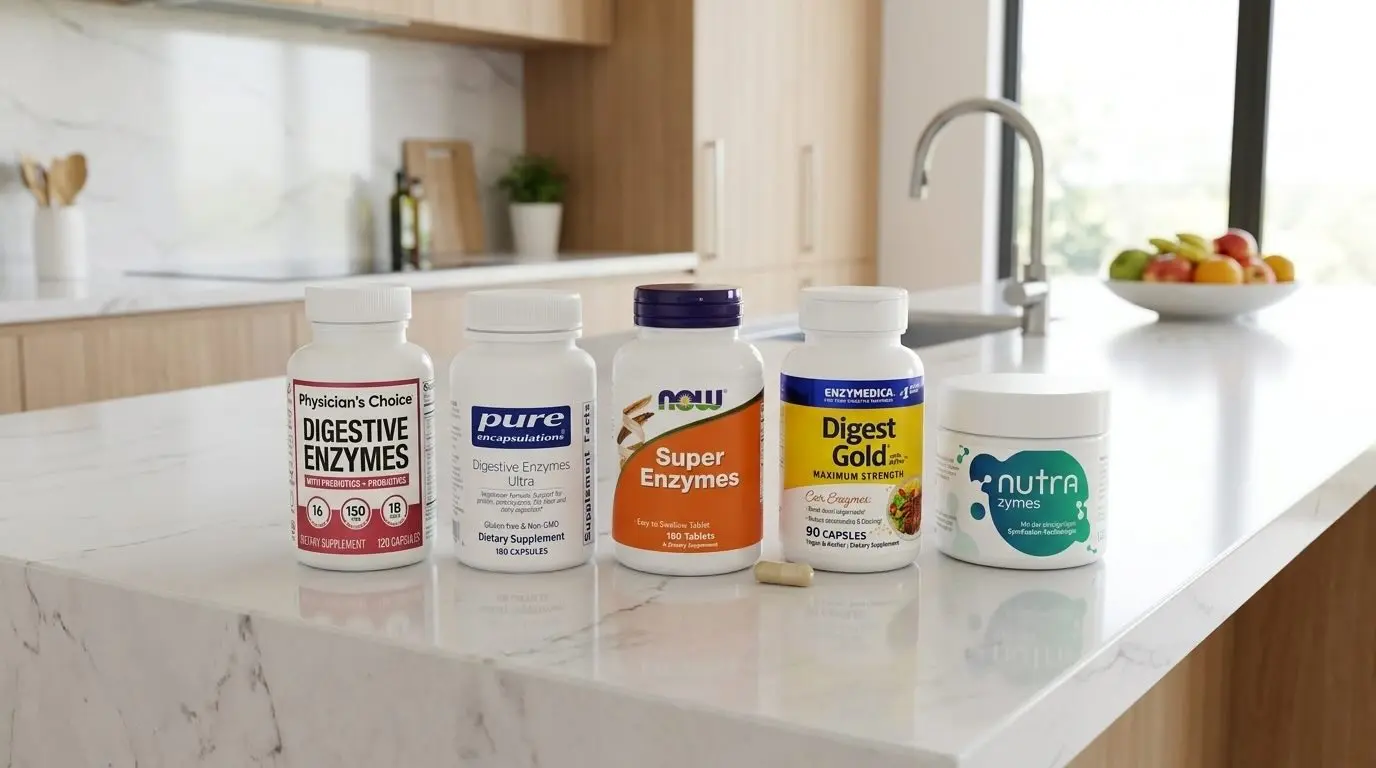
I tested five popular products under what I call my "lab lens" – from the ground up. Four out of five performed significantly weaker than expected. Often it wasn't just the formula itself, but a combination of insufficient activity levels, limited contact surface, and an outdated delivery method. Only one product genuinely delivered – both in the lab and in real use.
Let's take a closer look together.
When comparing everyday products, even a non-expert quickly runs into the same misunderstandings over and over. For this article, I've collected them and put each one in its proper scientific context.
 Misconception #1
"The more milligrams, the stronger the enzyme."
✅ The Truth:
Wrong. The milligram number simply describes the weight of the enzyme powder – not its activity. Two products with the exact same milligram count can differ in effectiveness by a factor of 20 to 40. What actually matters is enzyme activity – meaning how many substrates the enzyme can actually break down. Only activity units (DU, HUT, ALU, GAL, CU, FIP) give you any real insight into true performance.
Misconception #2
"Digestive enzymes in capsules work just as well as powder."
✅ The Truth:
No. Capsules dissolve late – and often unevenly – in the digestive tract. By the time the enzymes reach your meal, contact is already limited and there's little time left to become active. Powder, on the other hand, can be sprinkled directly onto your food and distributes evenly across the entire surface of the meal. This creates a significantly larger reaction surface, and the enzymes can start working immediately – a key advantage of modern powder formulations.
Misconception #3
"One enzyme product works for all digestive complaints."
✅ The Truth:
Digestive enzymes are highly specific: a product can only support digestion if it contains the exact enzymes needed for the particular nutrients causing the problem – and in sufficient activity levels. If an enzyme is missing or its activity is too low, digestion remains incomplete – even if other enzymes in the product are dosed generously. Only products with a broad, well-matched enzyme spectrum and high specific activity can offer comprehensive support.
Misconception #4
"Broad-spectrum enzymes from cheap sources work just as well."
✅ The Truth:
Absolutely not. Many low-cost enzymes have barely any activity at all – because they've been heavily diluted or processed in quantities too small to make a difference. The result: despite an impressive milligram number on the label, the effect simply doesn't show up.
Enzymes are evaluated worldwide by activity, not by milligrams. But most consumers have no idea.
Activity units like FCC, FIP, SAPU, LU, or AUT answer one specific question:

"How much substrate can this enzyme actually break down within a given period of time?" In other words: the amount isn't what decides effectiveness – it's the enzyme's capacity to become active.
Many manufacturers only list milligrams because their activity units would tell an unflattering story.
With high-quality enzyme supplements, it's the other way around:
 fewer mgbut extremely high activitysignificantly better digestive performance
A real example from our lab analysis:
Lab Comparison: Protease
Despite containing ten times less by weight, the second product is four times more effective. The reason: the enzyme strains are higher quality, fresher, and far more active.

That enzymatic support can make a measurable difference is backed by a randomized, placebo-controlled crossover study conducted with healthy adults suffering from postprandial fullness. Compared to placebo, taking an enzyme-based complex led to a significant reduction in abdominal bloating and the sensation of fullness after meals. Around 80% of participants reported a noticeable improvement compared to the placebo phase.
While the formulation studied cannot be equated with every enzyme product on the market, it reinforces a central point: what matters is not the milligram count on the label, but the functional activity of the enzymes involved in the digestive process.
 is sprinkled directly onto the meal rather than dissolved in water firstdistributes evenly across the entire surface of the foodcreates a significantly larger contact area for the enzymatic reactionbecomes active faster because the enzymes come into immediate contact with nutrientsis easy to dose and can be adjusted to individual needscontains no capsule shell that first needs to open or that may introduce poorly tolerated ingredients
Especially when dealing with digestive issues, the timing of enzyme activity is critical: the earlier an enzyme makes contact with food components, the more efficiently it can do its job.
A good enzyme product should be formulated so that the individual enzymes work in coordination with one another. That means:
 multiple enzymes covering the most important food componentssufficiently high activity levels so the enzymes can work in parallela clear, defined role for each enzymeno unnecessary additives that dilute the overall effect
Only when enzymes work together synergistically is food fully broken down into its smaller components. For the user, the benefit doesn't show up as an instant effect – it typically becomes noticeable within the following 30 to 60 minutes: the meal sits less heavily in the stomach, bloating occurs less frequently, and overall digestive comfort improves noticeably.
At first glance, it's often difficult to tell whether an enzyme product is actually high quality. Many packages look similar, the terminology sounds overly technical, and milligram numbers seem impressive – but say almost nothing about real effectiveness.
There are, however, a few quality markers that reliably indicate whether a product can actually deliver on its promises.
These criteria give consumers a reliable framework for clearly distinguishing high-quality enzyme supplements from products that simply don't deliver.
The quality criteria outlined above were fully applied to the following test and the results make clear just how differently these five products perform.
 Test Winner ⭐⭐⭐⭐⭐ (5/5)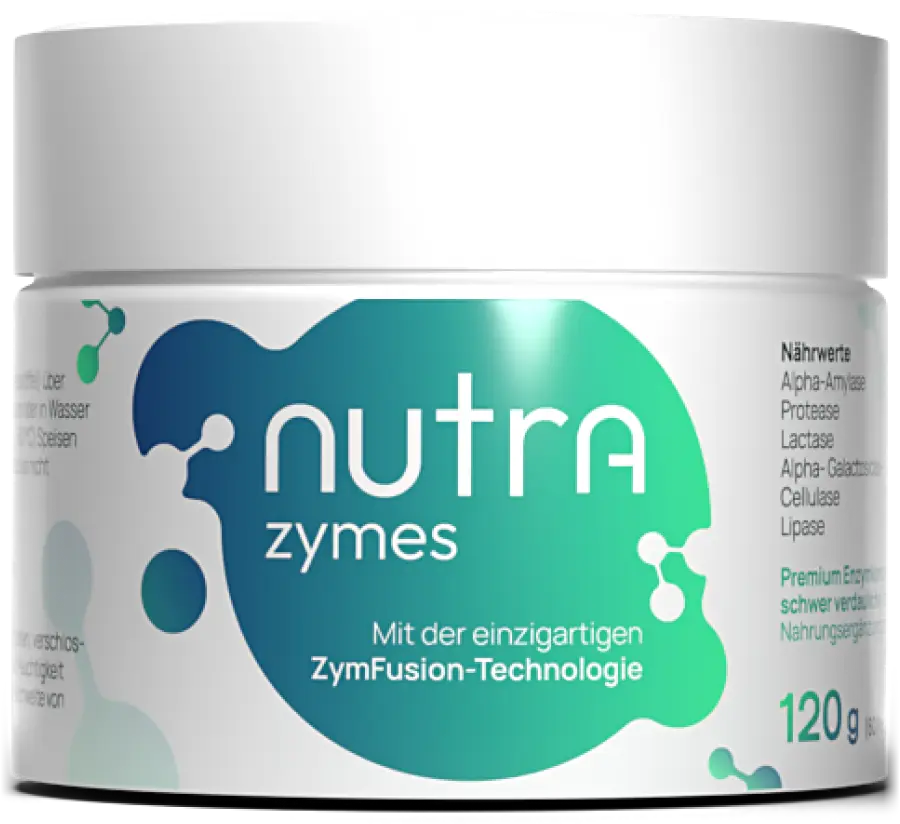
Quick Summary: Exceptionally high specific enzyme activity, complete substrate coverage, and early effectiveness thanks to its powder form. The most scientifically compelling product in the entire test.
Key Advantages:
Full coverage: proteins, fats, carbohydrates, lactose, fiber, oligosaccharides (GOS)Above-average activity units (including 14,400 DU, 11,700 HUT, 2,400 ALU)Powder form for early contact with foodNo fillers, modern enzyme strainsFully transparent labelingVerdict: Nutrazymes delivers exceptionally high performance across every quality category tested. It offers the most complete enzyme coverage in the entire comparison, lists high and clearly declared activity units, and uses a powder format that – when sprinkled onto food – creates a large contact surface so enzymes can begin reacting with nutrients right away.
The formula is clearly structured, free of fillers, and built on high-quality enzyme strains with strong specific activity.
Nutrazymes covers six relevant nutrient groups:
Rating: ⭐⭐⭐⭐⭐ 5/5
Nutrazymes lists all activity units in full – a significant advantage over products that only provide milligram amounts. The high specific activity of the enzyme strains enables efficient breakdown of the relevant substrates, even at lower milligram doses.
Rating: ⭐⭐⭐⭐⭐ 5/5
Because the powder is sprinkled directly onto the meal, it distributes across the entire food surface – creating a large contact area where enzymes can become active early in the digestive process. The effect typically becomes noticeable 30 to 60 minutes after eating, in the form of significantly better digestive comfort. Capsule products in this test became active noticeably later.
Rating: ⭐⭐⭐⭐⭐ 5/5
Nutrazymes uses modern enzyme strains from controlled manufacturing. Processing is high quality, purity is lab-verified, and the formula contains no fillers or low-cost diluting enzymes.
Rating: ⭐⭐⭐⭐⭐ 5/5
Every enzyme is listed alongside its corresponding activity unit. Many competing products, by contrast, only provide milligram counts – which reveal nothing about actual effectiveness.
Rating: ⭐⭐⭐⭐⭐ 5/5
Overall Rating: ⭐⭐⭐⭐⭐ 5/5 – Test Winner
Nutrazymes achieves top marks in every relevant category and presents the most scientifically sound formulation in the entire comparison.
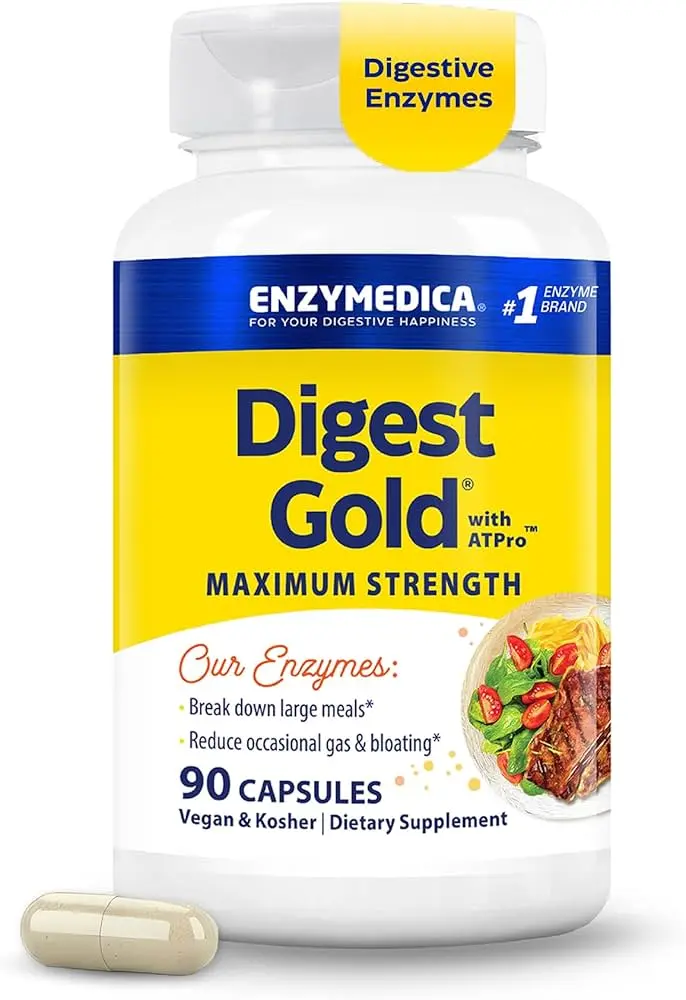
Enzymedica Digest Gold is one of the most recognized digestive enzyme products in the US and markets itself as the country's best-selling digestive supplement. The activity units are genuinely strong and clearly disclosed – Protease at 80,000 HUT and Amylase at 23,000 DU stand out positively.
That said, a closer look reveals some limitations. The 430mg blend includes the proprietary ATPro complex (CoQ10, ATP, Magnesium Citrate) – a nutrient blend with no enzymatic function that occupies space within the serving. Lipase comes in at 4,000 FIP and Lactase at 900 ALU, both noticeably lower than the test winner. Coverage for fiber fermentation and oligosaccharides (GOS) is incomplete. And as a capsule product, enzyme release is delayed.
 Pros:
Pros:
✅ Strong protease and amylase activity
✅ No artificial fillers or colors
✅ Widely available across the US
 Cons:
Cons:
❌ ATPro complex takes up blend space without adding enzymatic value
❌ Lipase and lactase activity below the test winner
❌ Capsule format limits speed and surface contact with food
❌ No coverage for GOS or complete fiber breakdown
 Verdict:
Digest Gold is a genuinely solid product and one of the better-formulated capsule options on the US market. The activity units are real and disclosed – that alone puts it ahead of most competitors. Where it falls short is in delivery: a capsule cannot match the immediate food-surface contact of a powder, which means part of its enzymatic potential is lost before it can fully engage.
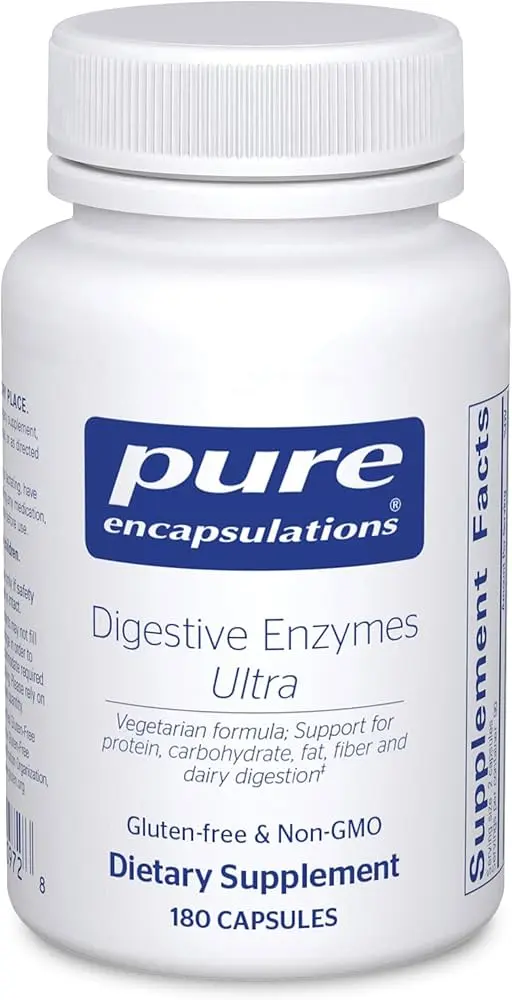
Pure Encapsulations Digestive Enzymes Ultra is frequently positioned as a professional-grade supplement and is popular in practitioner and clinical settings. On the positive side, activity units are clearly disclosed and the protease activity at 60,000 HUT is genuinely solid.
However, a full serving requires two capsules – which means the stated activity only kicks in when both are taken together. Coverage for fiber fermentation and oligosaccharides (GOS) is absent. Lipase comes in at 3,000 FIP, noticeably below the test winner.
Pros:
✅ Activity units fully disclosed
✅ Clean formula, free from common allergens and unnecessary additives
✅ Trusted brand in practitioner settings
Cons:
❌ Two capsules required per serving – easy to underdose
❌ No coverage for fiber or GOS
❌ Capsule format limits speed and surface contact with food
❌ High price relative to performance
Verdict:
Pure Encapsulations delivers a clean, honestly labeled product – and that matters. But requiring two capsules per meal is a practical limitation. The missing fiber and GOS enzymes mean it falls short for anyone eating varied or plant-rich meals. A reasonable choice for light, protein-focused eating – less so for anything more complex.
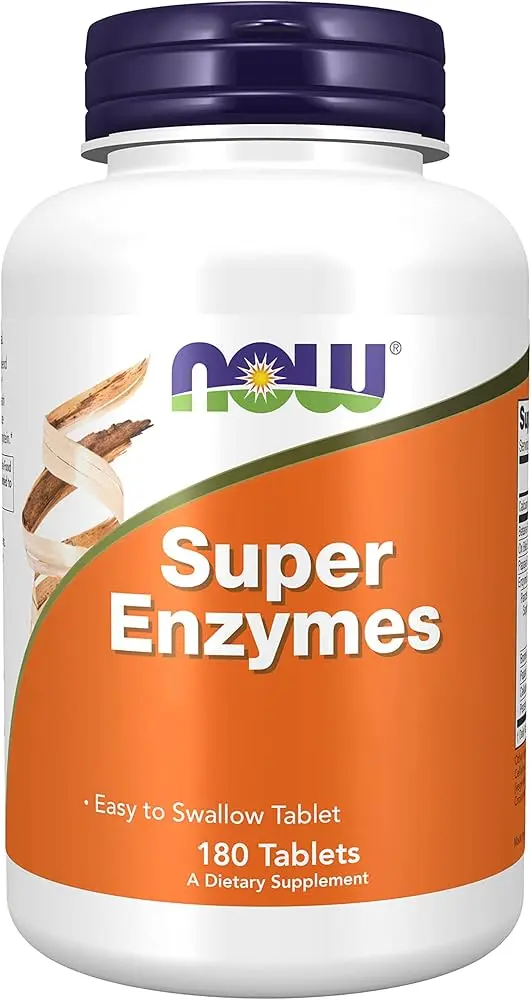
NOW Foods Super Enzymes is one of the most widely distributed enzyme supplements in the US and sits firmly in the budget segment. The product lists a range of enzymes, but the activity units are expressed in USP units rather than the FCC standard (HUT, DU, FIP) used across the rest of the industry – making any direct comparison practically impossible.
Coverage is limited to the basics: proteins, fats, and carbohydrates. Enzymes for fiber breakdown and oligosaccharides are absent. The formula contains animal-derived ingredients – ox bile and porcine pancreatin – along with fillers including magnesium stearate and microcrystalline cellulose.
Pros:
✅ Low price point
✅ Widely available across the US
✅ Covers basic macronutrient digestion
Cons:
❌ USP units instead of FCC – no meaningful comparison possible
❌ No fiber or GOS enzyme coverage
❌ Contains fillers (magnesium stearate, microcrystalline cellulose)
❌ Animal-derived ingredients – not suitable for vegetarians or vegans
❌ Gelatin capsule delays enzyme release
Verdict:
NOW Foods Super Enzymes is an accessible, low-cost option – but low cost comes with real trade-offs. The non-standard unit labeling makes it impossible to objectively assess how much enzymatic work is actually happening per serving. As an entry-level supplement for occasional, simple digestion support it may do something – but it can't compete on measurable performance.
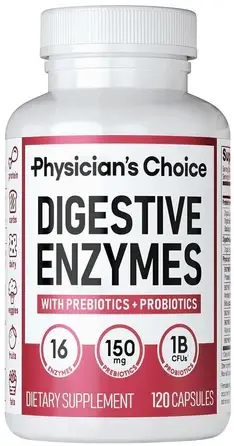
Physician's Choice Digestive Enzymes is one of the most heavily marketed enzyme products in the US, prominently advertising 16 different enzymes. On paper, that sounds comprehensive. In practice, the entire enzyme blend amounts to just 85mg per serving – and not a single activity unit is disclosed anywhere on the label.
There is no HUT, no DU, no FIP, no ALU. Nothing that would allow any objective assessment. The remaining capsule content is made up of a probiotic and prebiotic blend, along with an herbal support blend – ingredients that shift the product away from targeted enzymatic support and toward a general wellness supplement.
Pros:
✅ Low price point
✅ Widely available in the US
✅ Clean capsule ingredients
Cons:
❌ Zero activity units disclosed – no way to evaluate real effectiveness
❌ Total enzyme blend only 85mg across 16 enzymes
❌ Probiotic and herbal blends dilute the enzymatic focus
❌ Capsule format limits speed and food surface contact
❌ Classic milligram marketing with no performance data
Verdict:
Physician's Choice illustrates perfectly why the milligram number on a label can be meaningless. Sixteen enzymes sound impressive – but 85mg split across sixteen ingredients, with no activity units provided, tells you nothing about what this product actually does. For consumers who want measurable, verifiable digestive support, this product does not provide the transparency to make that judgment possible.
In direct comparison, nutrazymes was the only product to deliver fully across every category tested. The combination of high enzyme activity, complete substrate coverage, and the early-acting powder format makes it the clear winner.
While most competing products either list milligram counts only or are held back by delayed capsule release, nutrazymes offers digestive support that is both scientifically verifiable and genuinely comprehensive. Fully disclosed activity units across every enzyme, and a formula free of fillers, complete the picture.
 Highest specific enzyme activity of any product in this comparisonComplete coverage across all relevant nutrient groupsPowder format with maximum contact surface across the entire mealLab-verified quality and full label transparencyZero fillers
"For anyone looking for an enzyme supplement that doesn't just sound good on paper but delivers real, noticeable relief in everyday life, nutrazymes is the most compelling option in this comparison. Its high activity levels and complete substrate coverage make it equally well-suited for sensitive digestive systems and for heavy, complex meals."
— Sarah Mitchell, Personal Conclusion
 Exclusive Reader Offer
nutra biolabs is currently making a limited offer available exclusively for our readers. For a limited time, get up to 50% off nutrazymes – while supplies last.
This offer is time-limited and reserved specifically for visitors of this comparison.
▶ Claim Your Limited Offer Now 30-day money-back guarantee
If you don't experience the results you were hoping for, nutra biolabs offers a straightforward 30-day money-back guarantee. That makes nutrazymes an ideal starting point for anyone looking to try a high-quality enzyme supplement for the first time.
Sarah Mitchell is a biochemist and pharmacist specializing in digestive physiology and micronutrient research. Over the course of her career, she has focused particularly on the efficacy and quality of enzyme supplements and the standards by which they should be labeled.
In her work, she evaluates dietary supplements against scientific criteria including activity units, substrate specificity, and delivery format. For this comparison, she analyzed and assessed five enzyme supplements based on those same standards.
 A digestive enzyme and herbal dietary supplement reduces bloating in healthy adults: A randomized, placebo-controlled cross-over study. Randomized, placebo-controlled. View study →Digestive enzyme supplementation in gastrointestinal disorders — Review Article. Overview of the role of enzymes in functional digestive complaints. View study →